Monday, March 24, 2014

Record workshop day and a very sweet visitor!

Thanks to Jeana, Everett, Dan, Jed, Ann, and Angie, we were able to get a lot accomplished at Ahavas Sholom this past Saturday! This time we divided into teams and worked on three organizing/archival projects.

First, Dan, Ann, and Jeana worked to organize "Ligonier Schools 005" collection. They organized this collection into five archival boxes. A lot of the material in this collection is oversized and we still have these oversized items yet to organize next time.

Second, Jed and I worked on compiling the Historical Society's finding guide. As Jed brought each of the 49 boxes my way, we gave the box a title and recorded each folder's name. Now we are able to see the bulk of the holdings of the Historical Society as well as search by key word! As we add more information to this document, it will only become more and more useful to anyone and everyone interested in Ligonier's history.

Third, Jeana and Angie worked to organize the administrative materials of the Historical Society. While sorting through educational materials, guides, receipts, donation papers, and other items related to the Historical Society, Jeana and Angie also found many archival documents that were later interfiled into our five archival categories and 49 boxes.

The Kidd Marshmallow mural in Ligonier.
The Circle K "hecksher" (kosher symbol)
At around 2pm, we had a very sweet visitor to our workshop: Chris Kidd, of the former Kidd Marshmallow Company. Kidd Marshmallow Company was Ligonier staple for three generations before it recently closed. A few months ago, I received an inquiry from a filmmaker interested in making a film about American confection-making. He wanted photos and video footage of the Kidd Marshmallow Factory and Everett knew Chris would be the one to ask! Chris was nice enough to bring two videos and several photographs of Kidd Marshmallow when it was in operation. He also donated several other items of significance to the Historical Society. Before he left, I asked Chris how Kidd's made kosher marshmallows and he gave me the whole scoop! Twice a year (or so) Kidd's would close down normal operations and a Circle K rabbi would come to observe the cleaning of the equipment (of course the equipment was cleaned constantly, but twice a year a rabbi watched in order to certify the marshmallows as kosher). Then, the recipe was altered to substitute the regular gelatin with kosher beef gelatin. Chris told us a funny story about the testing that was involved for the kosher marshmallows and how they attempted to use a vegetable cellulose to make "pareve" (not meat or dairy) marshmallows. Disaster ensued as a tan-colored slime emerged! This was far from the delicious powdery-white fluffy marshmallows we all grew up with as.... Kidds.


Friday, February 28, 2014

Ligonier Jewish community papers... Check!

Even with a small crowd, this past Saturday we managed to sort all the Ligonier Jewish Community papers. We found all types of papers: personal correspondence, calling cards, bank statements, cemetery deeds, family photographs, business memos, meeting minutes, lawsuit papers, holiday cards, the list goes on and on! Some of the earliest materials dated to the 1880s. But we also found things, like these cancelled checks by the Ahavas Sholem Cemetery Association, as late as the 1960s.

All in all we sorted ten boxes of Jewish community materials (they are the boxes down in front in the photo below). Some of the papers were too large to put into the boxes. In these cases, we labelled them as "oversized materials" and will measure them for an appropriate box. 

Next up: March 22nd, our final set of 2D materials, Ligonier Schools! Please let me know if you'd like to volunteer to help us in this ongoing venture; if you love history like all of us, you'll fit right in! 

Wednesday, February 5, 2014

The Lost Shul in Burlington, VT

I just read this article in the Forward newspaper about a turn-of-the-century synagogue mural discovered in Burlington, VT. The community is calling the restoration of this mural and its relocation to a site nearby the "Lost Shul" project. The article describes the congregation who commissioned the mural as well as the accomplished artist who painted it. The story is truly one of inspiration and beauty.

Tuesday, January 21, 2014

27 boxes down! 2 more series to go!

This past Saturday Jeana, Everett, Cyndi, Dan and even Dan's wife and my mom came out to continue sorting archival subject "Ligonier People." We divided this subject into several series including "Beverforden family," "Churches," "Perry Township Home Economics Club," "Ligonier Regulators," and well, the list goes on and on! We've sorted piles of paper neatly into 27 tidy archival boxes so far. Nothing is more satisfying than lining the boxes up at the end of the day and soaking it all in!

While I think we've ordered enough letter-sized archival boxes and folders, I do think we'll need some additional archival supplies. If you'd like to donate one or more of the following to our project, please shoot me an email and I'll be happy to coordinate the donation!

  • Post it notes: just regular old 3x3 Post its in whatever color you can find. 
  • Plastic paper clips: (we probably need about 1,000 or more) 
  • Acid free paper to sandwich acidic photos (for now) and highly acidic newspaper clippings.
  • Archival box labels: Gaylord ML0600 acid-free shipping labels. 
  • Legal-sized archival folders: Gaylord AF200HW folders. 
We still have four more workshops scheduled for this spring and two more subject collections left to sort. In addition, we have several scrapbooks, ledgers, and other bound volumes to get through. Wish us luck, but better than that, come join us in our cataloging efforts in February!

Saturday, January 11, 2014

Indiana's historic synagogues are truly loved

Maggie of the Jewish Federation of St. Joseph Valley just sent me this wonderful video clip of the Sons of Israel synagogue in South Bend and the restoration work that was done there over the past few years. The synagogue is now a shop for baseball paraphernalia, but it has been immaculately restored and cared for.

The synagogue was built in 1901, making it the third-oldest synagogue still standing in Indiana (our very own Ahavas Sholom is the second-oldest), and boasts an incredible sanctuary, almost castle-like pillars, and an impressive facade. I have yet to visit the synagogue, but I have a feeling I will be going this summer to check out the building, see a baseball game and hopefully, get a kosher hot dog! I'm sure I can persuade my mom to come along... that won't be difficult!


Friday, December 27, 2013

A visit to Templo Libertad in Buenos Aires

This past November, my husband Micah and I travelled to Argentina on a late honeymoon. We spent the majority of our two weeks hiking and boating in the Patagonian region, but our last two days were spent in Buenos Aires. We wasted away lazy afternoons in many of the city parks watching families and their dogs enjoying their springtime weather while we relished the last days of warmth before heading back to our cold midwestern winter.
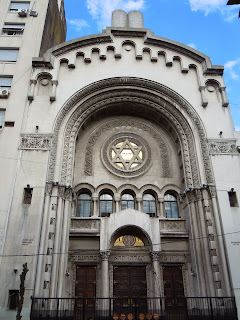
The exterior of Templo Libertad. Note the tablets
at the top- similar to those at Ahavas Sholom!
But before I could tackle all this relaxing, I had to see the gem of the city: Templo Libertad. We had only just dropped our luggage at the hotel minutes ago and I was already waiting impatiently at the door to head down the street. I strategically planned to stay a mere five blocks away from the synagogue. Camera and map in hand we headed out at 4:45 on Thursday afternoon. One guidebook stated the synagogue was open until 5:00. The synagogue's website said 3:00, and another guidebook didn't even include the opening hours. In addition, I had called a few days ago receiving no response. We had become accustomed to this type of confusion over the past two weeks and as a result, had missed out on several restaurants and other attractions. I was determined not to let this happen again. Knowing that the next day, Friday, was the start of Shabbat, I was afraid that if I didn't get in Thursday afternoon there would be no hope of seeing the building's interior. We ran down the sidewalk, dodging Yorkies, a few homeless squatters, cafe tables, baby carriages and flailing cigarettes and arrived at the synagogue on Libertad street which appeared to be completely secured, locked up, and just downright closed. I rattled the gate, walked to a side door and rang the bell. A few seconds later, a man arrived and told me the synagogue as well as the museum were closed. A feeling of sadness rushed over me but then I realized I had a human being in front of me! Not a guidebook! or a website! not voicemail! "What are tomorrow's hours?!" I managed to squeeze out between breaths. The guard said "11-3" just before closing the six-inch thick wood door in my face. I considered this success.
Yours truly in front of the synagogue.

Needless to say, we returned the next day at 11am. At the entrance, like any museum, they requested we purchase a ticket. However, unlike other museums in Argentina, they did not want pesos... they wanted US dollars. We paid for two tickets with a $20 bill and were directed to a young man who unfortunately had the flu, to give us a introduction to the museum. We walked through the 5-6 galleries which were elegantly done. The artifacts, like Argentina's Jewish population, came from all over the world. Captions and other museum text were in English as well as Spanish. A technique I really appreciated was their use of drawers. Each display case had 3-6 flat drawers underneath which visitors could, according to their own desire, pull out to read a letter, see a textile, or examine a silver platter. What a wonderful way to display 2D and low-profile items. I've seen this done before in children's museums and I've also seen this done in visible storage applications, but I thought this melded nicely within a formal history/art exhibit as well. In addition to the 2 and 3D artifacts, we viewed a short film on the Jewish Gauchos who settled in Moises Ville at the turn of the century. To read more about this fascinating commune funded by Baron de Hirsch, please check out this article.

Templo Libertad's sanctuary. Each pew had
a brass name plate. 
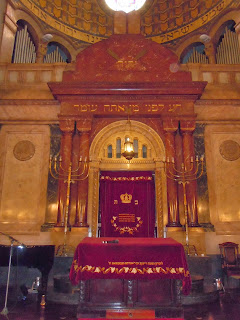
The bima of Templo Libertad. Note the organ
pipes pictured at top.  


A stained-glass chandelier in the foyer.
After finishing our tour of the museum, we moved on to a guided tour of the sanctuary itself. While this grandiose Byzantine-revival synagogue was completed in 1932, the congregation was formed over 70 years prior. The sanctuary was gilded in gold, festooned with marble imported from Europe, and embellished with incredible stained glass windows. The synagogue's congregation is Conservative today and according to our guide, the balcony was never used for women's seating but rather overflow seating. Also according to our guide, the organ pipes pictured above are working pipes. I would disagree because often religious buildings showcase faux pipes. The pipes doing all the work aren't all that pretty and uniform and need to be easily accessible for maintenance and repair. Regardless, we can glean a lot of information from this building, the people who built it, and the Jewish community today. First, the bima is at the front of the sanctuary which tells us that the service is more of a production than a participatory event where the bima is in the center of the sanctuary. Second, the organ is typical in the Reform movement but the balcony is typical of an Orthodox synagogue, yet the congregation is Conservative! Finally, we see a piano and a microphone at the front of the sanctuary. While I'm not positive these are used on Shabbat, these are hints that this congregation uses music as part of their services. If I was a specialist in architectural history or the history of the Jews in South America, I'm sure I would be able to extract even more information from this incredible building.

After our 2-hour tour of the museum and synagogue, we were hungry and decided to trek over to the only Kosher McDonald's outside of Israel. When we got there, in classic Argentine style, it was closed... unannounced.


Thursday, November 7, 2013

2013-2014 Workshops begin!

Jed and I were retroactively
invited to a "Hobo Party!"
We've closed the Ligonier Historical Society museum for the year, but the museum is as busy as ever. This past Saturday, Jed, Everett, Dan, Jeana, my mom (Nancy) and I began organizing the LHS archival collection. The collection consists of 2D materials such as newspaper clippings, photos, flyers, maps, notes, letters and postcards... the list goes on and on! Among the papers, we found a funny invitation to a "Hobo Party!"

We are using a typical archival organization process. We have five main "subjects"
1. Jewish community (001)
2. Ligonier people (002)
3. City of Ligonier (003)
4. Businesses in Ligonier (004)
5. Ligonier area schools (005)

Within these "subjects" we have several "series." These "series" vary depending on the "subject" they fall under. Here's a list of potential series:

o An organization (i.e. a government office, a school, a church)
o A business (i.e. Kids, Ligonier Leader, Solomon Meir Bank)
o A person (i.e. Bill Cochran, Jacob Straus, Tom Conner)
o An event (i.e. Marshmallow Festival, synagogue dedication, demolition of the school)

Then, within these "series" we have "sub-series." Here's a list of potential sub-series:
o financial records
o marketing materials
o meeting minutes
o correspondence
o newspaper clippings

Finally, within these sub-series, we organize the folders either chronologically or alphabetically depending on the type of material we are sorting.

We filled 10 of our new gray archival boxes with a lot of archival folders filled with a lot of materials covering Businesses in Ligonier (004) and City of Ligonier (003)! Archival boxes and folders are acid free and help to protect and preserve all of the LHS paper materials for years to come.

Our goal is to complete the Ligonier People (002) papers during our next session on November 23rd and then cover Jewish Community (001) in January. I hope more LHS members will come join us on November 23rd and get involved in the exciting work we are doing. What's more, for our last workshop, Jeana brought hot coffee and Dan brought amazing donuts from Creps Bakery. I can honestly say, I have never had a donut as good as these in all my 34 years on this planet. Please go there, buy lots of donuts, and try them for yourself.