Wednesday, August 10, 2016

Hoosiers: The Story of Indiana... Ligonier is featured!

Several months ago I was interviewed by WFYI in Indianapolis to speak about the historic cultural diversity in Ligonier. The four-part documentary, Hoosiers: The Story of Indiana, aired on the PBS station in July and August and is now online. I'm not sure for how long though. 


If you’re short on time, just watch minute 47:00 to minute 53:00. These six minutes feature Ligonier and the historic synagogue as well as the vibrant Latino community the town boasts today. 


Thursday, April 14, 2016

Back home again.... in Indiana

What a great time to move back to Indiana. My husband, daughter (a few days shy of 18 months), and I moved to Northeast Indiana just a few weeks ago. I haven't lived in the State since 2000 when I graduated from Indiana University in Bloomington. Initially I thought coming back would be a bit of culture shock, but everything is just as I left it. My dissertation is a few revisions away from being done (defense May 24) and it's great to be nearer to family and enjoy all the comforts of home.

2016 is momentous for other reasons, it's Indiana's bicentennial. I was asked to participate in the four-part PBS documentary celebrating the bicentennial only a few days after we moved. The film crew asked me questions about Ligonier's Jewish history, what lessons we could learn about its diverse past, and what makes me a Hoosier. Needless to say, the first two questions were much easier to answer. We'll see what makes the final cut, or if I even make it in the documentary at all.

When I was back in Ligonier I saw a few things that disturbed me. First, Creps' bakery closed. Creps' was home to the cream center doughnut and I have fond memories of Dan Replogle bringing these to our all-day cataloging work sessions. Bye bye Creps', you will be missed-especially by my daughter who never even had the chance to taste a cream center. Shall we hope you may reopen someday?

Second, I saw the "For Sale" sign outside Ahavath Sholom and what's more, after a recent storm, several asphalt shingles strew around the yard. My heart aches for this building as it sits waiting for a new owner. The community loves this "gem of Ligonier" and we all want to see it with a rightful caretaker and a new roof.

As I unpack boxes in my new house, I wonder... just who will unpack theirs at Ahavath Sholom? Will it be this year or next? Will it be a family or a business? Will it be locals or out-of-towners? It seems to risky to leave up to chance.  

Monday, January 19, 2015

The synagogue is for sale

1/9/2015 Kendallville News Sun article in the
Indiana Economic Digest regarding the sale.
This past fall I neglected my usual posting duties because I've been head over heels in love with my new baby girl. Eleora Margalit was born on October 17th and she's taken over the world as I knew it. She is named after her four great-grandmothers: Leona, Lenore, Eleanor, and Margaret (all in blessed memory). In Hebrew, her name means "Light of God" and "Pearl." But as I changed diapers and watched this bundle of joy double in size in her first three months, the historic 1889 Ahavath Sholom synagogue is now for sale.
1/16/2015 Goshen News article 
regarding the sale

This news was not a shock to the Ligonier Historical Society. Before the Indiana Historic Marker dedication, Jerry Nesbitt of the Ligonier Public Library, told the group that due to the Library's recent renovations, they were operating in a deficit. Looking to liquidate any assets to minimize this deficit, the Library Board was considering selling Ahavath Sholom. Jerry has been a long-time advocate for the building not to mention an avid historian himself.

At first Jerry asked me if I might have any ideas of individuals or organizations who may be interested in purchasing it. My initial thoughts went out to Indiana's Jewish community. Perhaps if we joined forces we could come together, like we did for the historic marker, to ensure the building stays as is, or better yet, restored.

Then I had a baby and my volunteer efforts in Ligonier took a back seat for a few months. But over the past two weeks, local Indiana media published several articles regarding the pending sale of the synagogue. These articles have caused a flurry of phone calls, emails, and letters (yes, actual paper letters) about the building and have reminded me that I need to reach out to the Indiana, and maybe even the Midwest, Jewish community to make sure they are aware that this beautiful building is for sale.

The Ligonier Historical Society is taking a hiatus in collection organization and stabilization this winter. Once the new owner of the building is identified, the collections may need to be relocated but this is still unclear. As new, concrete information surfaces, I will be sure to post it here.

In other news, thanks to the hard work of Sheryl Prentice, the Noble County Visitors Bureau was selected to participate in a "Bicentennial 2016: The Next Indiana" workshop to help promote Ligonier's historic Jewish heritage to tourists. The kickoff meeting is this Friday the 23rd and I am excited to hear what comes about from the planning!


Tuesday, September 23, 2014

Indiana Historical Marker Dedicated!

This past labor day, about 75-100 people gathered at Ahavath Sholom to dedicate an Indiana Historical marker. This marker was the result of almost two years of fundraising, researching, and writing and it was all worth it. The Ligonier Historical Society got a 125th birthday cake for the 1889 Ahavath Sholom synagogue building, we had a silent auction and period liturgical music playing in the background, and yours truly gave an architectural building tour! While it was swelteringly hot, the mayor of Ligonier came to celebrate with us as we dedicated the marker and read a poem that was read during the dedication of the building, 125 years ago. 

Below is the text of the marker that is cast aluminum, powder-coated blue with gold-lettering.

Side 1:
German Jews immigrated to the U.S. in greater numbers starting in the 1850s. In the 1860s,
Ligonier’s Jewish residents formed the congregation Ahavath Sholom (Hebrew for “peace loving”) and circa 1867, built a small synagogue nearby. The congregation formed close relationships with local churches. The Jewish community prospered, providing civic and business leaders.

Side 2:
In 1889, the congregation dedicated a new synagogue here. Rabbi Isaac Mayer Wise, founder of American Reform Judaism, spoke on religious tolerance at the dedication; the celebration included people from other cities and states. Jewish population peaked around 1900, later declining as younger residents moved to larger cities for educational and economic opportunities.

Credit Line:
Installed 2014 Indiana Historical Bureau, Ligonier Historical Society, Ligonier Public Library, and Indiana Jewish Federation Friends of Ahavath Sholom. 

If there had been more space on the sign, we would have loved to individually list the names of our generous donors whose excitement and monetary contributions made the marker possible: the Jewish Federation of Northwest Indiana; the Jewish Federation of Fort Wayne; the Jewish Federation of Greater Indianapolis; the Jewish Federation of St. Joseph Valley in South Bend; and the Michiana Jewish Historical Society.

Wednesday, May 14, 2014

It's all happening so fast!

There is so much happening at Ahavas Sholom this month that I have to share with you my excitement!

First, the Ligonier Historical Society (LHS) has finished cataloging all the 3D objects and 2D paper items in the collection. This process has taken two years and would not have been possible without the help of all the LHS member-volunteers. Once our catalogs and finding guide are finalized this fall, I will be posting them to the blog so researchers, Ligonier community members, and anyone who is interested can dig around and discover what's available at the LHS.
Archival boxes hold hundreds of years of Ligonier paper items.
Post-it notes will be replaced this week with permanent box labels. 
3D items were placed in waterproof tubs and inventoried for lower level storage.
Archival silica packets placed inside the tubs wick away any additional moisture.
Items too big for the tubs will be stored on the main level. 

Secondly, last year, we applied for an Indiana Historic Marker. The application process was quite competitive and there were three long steps involved. The cost of the marker is $2,050 and all four Jewish Federations and the Michiana Jewish Historical society have pledged funds to make up the balance of the marker and I am taking care of all the administrative tasks as a volunteer. The Ligonier Historical Society will host the dedication celebration festivities in early-mid September. More updates on this to come later this month! I truly believe that State recognition (the building is already on the National Register for Historic Places) will help us not only to secure future funding, but also to insure the building is maintained and appreciated for years to come. Learn all about Indiana's historic marker program by clicking here! 

Finally, the LHS/1889 Ahavas Sholom Temple building will be open for visitors by the end of the month. The summer exhibit celebrating the 125th anniversary of the temple will take visitors back in time to what Ligonier looked like in the 1880s and 1890s. Stay tuned for a "Visitors" tab to include opening dates, times, and contact information!


Monday, March 24, 2014

Record workshop day and a very sweet visitor!

Thanks to Jeana, Everett, Dan, Jed, Ann, and Angie, we were able to get a lot accomplished at Ahavas Sholom this past Saturday! This time we divided into teams and worked on three organizing/archival projects.

First, Dan, Ann, and Jeana worked to organize "Ligonier Schools 005" collection. They organized this collection into five archival boxes. A lot of the material in this collection is oversized and we still have these oversized items yet to organize next time.

Second, Jed and I worked on compiling the Historical Society's finding guide. As Jed brought each of the 49 boxes my way, we gave the box a title and recorded each folder's name. Now we are able to see the bulk of the holdings of the Historical Society as well as search by key word! As we add more information to this document, it will only become more and more useful to anyone and everyone interested in Ligonier's history.

Third, Jeana and Angie worked to organize the administrative materials of the Historical Society. While sorting through educational materials, guides, receipts, donation papers, and other items related to the Historical Society, Jeana and Angie also found many archival documents that were later interfiled into our five archival categories and 49 boxes.

The Kidd Marshmallow mural in Ligonier.
The Circle K "hecksher" (kosher symbol)
At around 2pm, we had a very sweet visitor to our workshop: Chris Kidd, of the former Kidd Marshmallow Company. Kidd Marshmallow Company was Ligonier staple for three generations before it recently closed. A few months ago, I received an inquiry from a filmmaker interested in making a film about American confection-making. He wanted photos and video footage of the Kidd Marshmallow Factory and Everett knew Chris would be the one to ask! Chris was nice enough to bring two videos and several photographs of Kidd Marshmallow when it was in operation. He also donated several other items of significance to the Historical Society. Before he left, I asked Chris how Kidd's made kosher marshmallows and he gave me the whole scoop! Twice a year (or so) Kidd's would close down normal operations and a Circle K rabbi would come to observe the cleaning of the equipment (of course the equipment was cleaned constantly, but twice a year a rabbi watched in order to certify the marshmallows as kosher). Then, the recipe was altered to substitute the regular gelatin with kosher beef gelatin. Chris told us a funny story about the testing that was involved for the kosher marshmallows and how they attempted to use a vegetable cellulose to make "pareve" (not meat or dairy) marshmallows. Disaster ensued as a tan-colored slime emerged! This was far from the delicious powdery-white fluffy marshmallows we all grew up with as.... Kidds.


Friday, February 28, 2014

Ligonier Jewish community papers... Check!

Even with a small crowd, this past Saturday we managed to sort all the Ligonier Jewish Community papers. We found all types of papers: personal correspondence, calling cards, bank statements, cemetery deeds, family photographs, business memos, meeting minutes, lawsuit papers, holiday cards, the list goes on and on! Some of the earliest materials dated to the 1880s. But we also found things, like these cancelled checks by the Ahavas Sholem Cemetery Association, as late as the 1960s.

All in all we sorted ten boxes of Jewish community materials (they are the boxes down in front in the photo below). Some of the papers were too large to put into the boxes. In these cases, we labelled them as "oversized materials" and will measure them for an appropriate box. 

Next up: March 22nd, our final set of 2D materials, Ligonier Schools! Please let me know if you'd like to volunteer to help us in this ongoing venture; if you love history like all of us, you'll fit right in! 

Wednesday, February 5, 2014

The Lost Shul in Burlington, VT

I just read this article in the Forward newspaper about a turn-of-the-century synagogue mural discovered in Burlington, VT. The community is calling the restoration of this mural and its relocation to a site nearby the "Lost Shul" project. The article describes the congregation who commissioned the mural as well as the accomplished artist who painted it. The story is truly one of inspiration and beauty.

Tuesday, January 21, 2014

27 boxes down! 2 more series to go!

This past Saturday Jeana, Everett, Cyndi, Dan and even Dan's wife and my mom came out to continue sorting archival subject "Ligonier People." We divided this subject into several series including "Beverforden family," "Churches," "Perry Township Home Economics Club," "Ligonier Regulators," and well, the list goes on and on! We've sorted piles of paper neatly into 27 tidy archival boxes so far. Nothing is more satisfying than lining the boxes up at the end of the day and soaking it all in!

While I think we've ordered enough letter-sized archival boxes and folders, I do think we'll need some additional archival supplies. If you'd like to donate one or more of the following to our project, please shoot me an email and I'll be happy to coordinate the donation!

  • Post it notes: just regular old 3x3 Post its in whatever color you can find. 
  • Plastic paper clips: (we probably need about 1,000 or more) 
  • Acid free paper to sandwich acidic photos (for now) and highly acidic newspaper clippings.
  • Archival box labels: Gaylord ML0600 acid-free shipping labels. 
  • Legal-sized archival folders: Gaylord AF200HW folders. 
We still have four more workshops scheduled for this spring and two more subject collections left to sort. In addition, we have several scrapbooks, ledgers, and other bound volumes to get through. Wish us luck, but better than that, come join us in our cataloging efforts in February!

Saturday, January 11, 2014

Indiana's historic synagogues are truly loved

Maggie of the Jewish Federation of St. Joseph Valley just sent me this wonderful video clip of the Sons of Israel synagogue in South Bend and the restoration work that was done there over the past few years. The synagogue is now a shop for baseball paraphernalia, but it has been immaculately restored and cared for.

The synagogue was built in 1901, making it the third-oldest synagogue still standing in Indiana (our very own Ahavas Sholom is the second-oldest), and boasts an incredible sanctuary, almost castle-like pillars, and an impressive facade. I have yet to visit the synagogue, but I have a feeling I will be going this summer to check out the building, see a baseball game and hopefully, get a kosher hot dog! I'm sure I can persuade my mom to come along... that won't be difficult!


Friday, December 27, 2013

A visit to Templo Libertad in Buenos Aires

This past November, my husband Micah and I travelled to Argentina on a late honeymoon. We spent the majority of our two weeks hiking and boating in the Patagonian region, but our last two days were spent in Buenos Aires. We wasted away lazy afternoons in many of the city parks watching families and their dogs enjoying their springtime weather while we relished the last days of warmth before heading back to our cold midwestern winter.
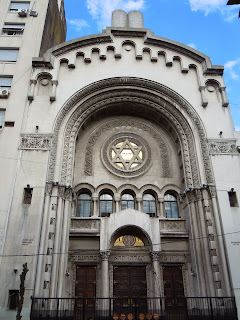
The exterior of Templo Libertad. Note the tablets
at the top- similar to those at Ahavas Sholom!
But before I could tackle all this relaxing, I had to see the gem of the city: Templo Libertad. We had only just dropped our luggage at the hotel minutes ago and I was already waiting impatiently at the door to head down the street. I strategically planned to stay a mere five blocks away from the synagogue. Camera and map in hand we headed out at 4:45 on Thursday afternoon. One guidebook stated the synagogue was open until 5:00. The synagogue's website said 3:00, and another guidebook didn't even include the opening hours. In addition, I had called a few days ago receiving no response. We had become accustomed to this type of confusion over the past two weeks and as a result, had missed out on several restaurants and other attractions. I was determined not to let this happen again. Knowing that the next day, Friday, was the start of Shabbat, I was afraid that if I didn't get in Thursday afternoon there would be no hope of seeing the building's interior. We ran down the sidewalk, dodging Yorkies, a few homeless squatters, cafe tables, baby carriages and flailing cigarettes and arrived at the synagogue on Libertad street which appeared to be completely secured, locked up, and just downright closed. I rattled the gate, walked to a side door and rang the bell. A few seconds later, a man arrived and told me the synagogue as well as the museum were closed. A feeling of sadness rushed over me but then I realized I had a human being in front of me! Not a guidebook! or a website! not voicemail! "What are tomorrow's hours?!" I managed to squeeze out between breaths. The guard said "11-3" just before closing the six-inch thick wood door in my face. I considered this success.
Yours truly in front of the synagogue.

Needless to say, we returned the next day at 11am. At the entrance, like any museum, they requested we purchase a ticket. However, unlike other museums in Argentina, they did not want pesos... they wanted US dollars. We paid for two tickets with a $20 bill and were directed to a young man who unfortunately had the flu, to give us a introduction to the museum. We walked through the 5-6 galleries which were elegantly done. The artifacts, like Argentina's Jewish population, came from all over the world. Captions and other museum text were in English as well as Spanish. A technique I really appreciated was their use of drawers. Each display case had 3-6 flat drawers underneath which visitors could, according to their own desire, pull out to read a letter, see a textile, or examine a silver platter. What a wonderful way to display 2D and low-profile items. I've seen this done before in children's museums and I've also seen this done in visible storage applications, but I thought this melded nicely within a formal history/art exhibit as well. In addition to the 2 and 3D artifacts, we viewed a short film on the Jewish Gauchos who settled in Moises Ville at the turn of the century. To read more about this fascinating commune funded by Baron de Hirsch, please check out this article.

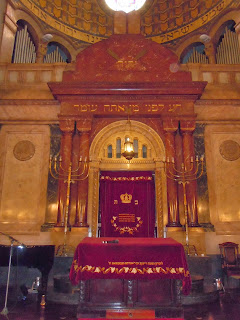
Templo Libertad's sanctuary. Each pew had
a brass name plate. 
The bima of Templo Libertad. Note the organ
pipes pictured at top.  


A stained-glass chandelier in the foyer.
After finishing our tour of the museum, we moved on to a guided tour of the sanctuary itself. While this grandiose Byzantine-revival synagogue was completed in 1932, the congregation was formed over 70 years prior. The sanctuary was gilded in gold, festooned with marble imported from Europe, and embellished with incredible stained glass windows. The synagogue's congregation is Conservative today and according to our guide, the balcony was never used for women's seating but rather overflow seating. Also according to our guide, the organ pipes pictured above are working pipes. I would disagree because often religious buildings showcase faux pipes. The pipes doing all the work aren't all that pretty and uniform and need to be easily accessible for maintenance and repair. Regardless, we can glean a lot of information from this building, the people who built it, and the Jewish community today. First, the bima is at the front of the sanctuary which tells us that the service is more of a production than a participatory event where the bima is in the center of the sanctuary. Second, the organ is typical in the Reform movement but the balcony is typical of an Orthodox synagogue, yet the congregation is Conservative! Finally, we see a piano and a microphone at the front of the sanctuary. While I'm not positive these are used on Shabbat, these are hints that this congregation uses music as part of their services. If I was a specialist in architectural history or the history of the Jews in South America, I'm sure I would be able to extract even more information from this incredible building.

After our 2-hour tour of the museum and synagogue, we were hungry and decided to trek over to the only Kosher McDonald's outside of Israel. When we got there, in classic Argentine style, it was closed... unannounced.


Thursday, November 7, 2013

2013-2014 Workshops begin!

Jed and I were retroactively
invited to a "Hobo Party!"
We've closed the Ligonier Historical Society museum for the year, but the museum is as busy as ever. This past Saturday, Jed, Everett, Dan, Jeana, my mom (Nancy) and I began organizing the LHS archival collection. The collection consists of 2D materials such as newspaper clippings, photos, flyers, maps, notes, letters and postcards... the list goes on and on! Among the papers, we found a funny invitation to a "Hobo Party!"

We are using a typical archival organization process. We have five main "subjects"
1. Jewish community (001)
2. Ligonier people (002)
3. City of Ligonier (003)
4. Businesses in Ligonier (004)
5. Ligonier area schools (005)

Within these "subjects" we have several "series." These "series" vary depending on the "subject" they fall under. Here's a list of potential series:

o An organization (i.e. a government office, a school, a church)
o A business (i.e. Kids, Ligonier Leader, Solomon Meir Bank)
o A person (i.e. Bill Cochran, Jacob Straus, Tom Conner)
o An event (i.e. Marshmallow Festival, synagogue dedication, demolition of the school)

Then, within these "series" we have "sub-series." Here's a list of potential sub-series:
o financial records
o marketing materials
o meeting minutes
o correspondence
o newspaper clippings

Finally, within these sub-series, we organize the folders either chronologically or alphabetically depending on the type of material we are sorting.

We filled 10 of our new gray archival boxes with a lot of archival folders filled with a lot of materials covering Businesses in Ligonier (004) and City of Ligonier (003)! Archival boxes and folders are acid free and help to protect and preserve all of the LHS paper materials for years to come.

Our goal is to complete the Ligonier People (002) papers during our next session on November 23rd and then cover Jewish Community (001) in January. I hope more LHS members will come join us on November 23rd and get involved in the exciting work we are doing. What's more, for our last workshop, Jeana brought hot coffee and Dan brought amazing donuts from Creps Bakery. I can honestly say, I have never had a donut as good as these in all my 34 years on this planet. Please go there, buy lots of donuts, and try them for yourself.

Monday, August 5, 2013

Busy busy busy!

It's summer in the midwest but the Ligonier Historical Society is busy nonetheless. Over the last month, society members have: (in no particular order!)

  • Ordered (and received) a pallet of archival boxes and folders
  • Driven all over Indiana donating orphaned items to historical societies
  • Gone to the Indiana Historical Society archives in Indianapolis
  • Hunted down newspaper articles from 1889
  • Worked on compiling the Indiana Historical Marker application
  • Gathered donation pledges for the Indiana Historical Marker 
  • Staffed the Ligonier Historical Society museum at the Ahavas Sholom temple
  • Reviewed our newly finished feasibility study
  • Planned (and planning) our next set of cataloging workshops
  • Began transcribing the Ahavas Sholom congregational minutes from the American Jewish Archives
Two pages from the Ahavas Sholom minutes book
We are looking for volunteers to help transcribe these minutes and already have 30 out of 140 pages spoken for. If you'd like to polish your skills at reading late 19th early 20th century cursive writing, please send me an email and I'd be glad to give you a set of 10 pages to transcribe! Our goal is transcription of the entire minutes book by then end of the year.


    Tuesday, July 16, 2013

    Indiana Historical Marker

    In February I submitted an application to the Indiana Historical Bureau for an historical marker for Ligonier's 1889 Ahavas Sholom Temple building. The marker would be a big step in getting the State of Indiana to recognize the historical cultural and religious tolerance in Northern Indiana and to help preserve the building for generations to come. The application process is complicated and involves three steps. 
    1. Intent to Apply
    2. Detailed application and proof of funding
    3. Indiana Historical Marker in front of the
      Noble County Courthouse
    4. Historical research
    We are currently in the middle of step two and I am brainstorming ways of locating the $2,050 needed for the marker. The marker seems like the perfect thing to fundraise for: it is permanent, it makes a lasting impression, it creates a media buzz, it helps to preserve the building, it is eye-catching, and it tells the story (in brief) about the building to passersby, the list goes on and on. If anyone has any ideas about ways to fundraise for this unique historical marker, please don't hesitate to send me an email. The deadline to complete step two is August 12th! 


    Tuesday, June 11, 2013

    Rural Jewish communities in America's past

    Today I read an article about a part-wood part-concrete/stone 19th century mikveh excavated in rural Connecticut. A mikveh is a ritual bath used by Orthodox, or religiously observant, Jews to observe several commandments. While the mikveh is a common find among Orthodox communities in urban areas, it is virtually non-existent in rural communities. For example, our synagogue, Ahavas Sholom, was home to a Reform Jewish congregation and does not have a mikveh. In fact, many congregations that ventured out beyond the comforts of large urban areas like New York City, Boston, and Chicago were Reform congregations and did not observe many of the ritual commandments in the Torah. 

    However, the congregation in Old Chesterfield, CT must have been Orthodox. Archaeologists recently found a mikveh- quite possibly the only mikveh in existence in rural America. It is a physical wake up call to scholars that not all rural congregations in America were Reform. If you are interested in reading more about this archaeological find, take a look at the article "Overlooked Chapter of Jewish History" on University of Connecticut's website. 


    Tuesday, April 16, 2013

    Temple Israel in Colorado

    I was reading the Council of American Jewish Museum's (CAJM) newsletter and ran across this great synagogue museum in Colorado. I wanted to bring it to your attention and to celebrate the great work these folks out West are doing. Temple Israel, in Leadville, Colorado, was established in 1884 (just five years before our very own Ahavas Sholom). Read more about this awesome pioneer synagogue and its restoration here: http://www.jewishleadville.org/

    Monday, April 15, 2013

    Historical Society Volunteers Finish Cataloging Objects!

    Wow! Last Saturday the team of volunteers from the Historical Society really came together to get a lot done. We started the day with a fairly messy temple/museum and ended with one that is almost ready to be opened to the public! This past Saturday Jerry, Everett, Cyndi, and Jeana finished cataloging all of the 3D objects (872 total overall) while Jed and I did the heavy lifting, organizing and moving - LOTS OF IT!

    Before cataloging began.
    Objects hung on the wall detracted
    from the building's historic significance.
    Our goal is to open the museum on Memorial Day Weekend for the summer with a new temporary exhibit. The exhibit includes 30 objects from the Society's collection which help tell the story of the Ligonier community from 1860-1980. The exhibit will be open until the fall when the museum closes its doors for the winter.

    The front of the sanctuary will be interpreted to show what the space would have looked like to Jewish worshippers in 1889. We do not have many of the original artifacts from the temple, but we do have the best object of all- the temple itself!

    Baum & Son pump organ,
    original pew, Union Prayer Book,
    and King David stained glass window
    The Torah "Ark" with
    Hebrew 10 Commandments,
    American flag, and bimah (scroll table)
    Cleaning and de-cluttering allows visitors to see the walls of the building and celebrate its stained glass windows. Visitors will now be able to feel what it was like to step inside a 19th century synagogue. There's still a lot of work left to be done but luckily, we have a team of dedicated, hard-working volunteers who just happen to love history!

    Monday, March 25, 2013

    Marathon Cataloging day!

    This past Saturday, Jerry, Jeana, Angie, Jed, Cyndi, and I worked to catalog all of section 001 "Jewish community" and part of section 004, "Ligonier Businesses." We impressively finished section 001 before lunch and made great progress on 004 in the afternoon. We still have quite a bit of work to do on 004 as well as several other areas left untouched. First, there is a 15' shelf full of books and scrapbooks that have yet to be cataloged. Second, there are a lot of administrative materials that need to be organized. Thirdly, there are two groups of materials "unknown" and "non-Ligonier history" that need to be sorted and, if necessary, deaccessioned. Finally, there is all the 2D items (paper, photos, letters, etc) that have to be sorted and filed into appropriate archival boxes.

    Level One Hebrew Primer
    We had a record day on Saturday, cataloging 324 items, bringing our total of cataloged items to 683! Our next workday is Saturday, April 13. Since Everett was unable to join us on Saturday, I must end this post with a highlight from section 001 for him. This is a snapshot of a few pages from an undated Hebrew Primer which would have been used at the Ahavas Sholom Hebrew School. "Where is the dog?" "The dog is under the table." "Where is the cat?" "The cat is on the chair." While we tend to focus on the well-known influential Jews in Ligonier like Solomon Mier and Jacob Straus, this primer is a reminder that it was truly a community, and yes, that includes kids! 

    Monday, February 18, 2013

    Four down, two to go!


    Saturday marked our fourth (out of six total) workshops at the Ligonier Historical Society. Many, many thanks to Jerry, Jeana and Everett who worked with me to catalog sections 003 (Ligonier Government) and 005 (Ligonier Schools). We cataloged 192 three-dimensional objects and finished both of these sections! We have two sections left: 001 (Jewish community) and 004 (Ligonier businesses). As expected, we ran into some items which needed to be moved to other categories, and some items which we felt did not help tell the story of Ligonier's history. Around noon, Kurt Garner, an architect who specializes in Historic Preservation, met with us to discuss a report that we need to compile in order to apply for an NEH grant this summer. This report will be funded by the grant we received from Indiana Landmarks last year. 

    Mr. Whiz looks a bit sleepy!
    When we finish cataloging all of the three-dimensional objects, we will move on to the micro-work. The micro-work includes moving through each of the sections again with the two-dimensional items like photographs, newspaper clippings, letters, and other paper. These will be separated into folders and then organized into archival boxes. More updates on this later, but for now, a highlight from our work on section 005, Ligonier Schools: the cover of the 1960 Ligonier "Lance" yearbook featuring "Mr. Whiz!"